.png)
What Is Text Analytics and Why Does It Matter in CX?
The problem is not that your customers aren’t speaking. It’s that you’re not understanding them fast enough. If you want to decode open-ended responses at scale, you need a system that converts unstructured text into structured, decision-ready insights.
That system is text analytics.
Instead of manually reading thousands of responses, text analytics uses AI and NLP to identify patterns, detect sentiment, extract themes, and connect feedback to business outcomes.
In modern CX environments, text analytics increasingly supports a structured operational workflow: Signal → Context → Insight → Alert → Action → Outcome
1. Customer feedback becomes structured operational signals
2. AI identifies recurring patterns and friction points
3. Teams gain visibility into customer context faster
4. Alerts improve operational coordination
5. Actions help reduce customer friction and improve experience outcomes
6. Business impact becomes measurable across retention, efficiency, and operational performance
This is how organizations move from passive feedback collection toward more actionable CX operations.
If you look at your organization today, you probably have no shortage of feedback.
You are collecting:
On paper, this looks like a strong CX foundation.
You have:
Despite all this data, most teams struggle to answer simple questions like:
Because:
You have visibility into feedback
But not clarity into meaning
Core Insight: Collecting feedback alone does not improve customer experience.

Many teams still treat text analytics as a reporting feature. That perspective is outdated.
Modern Definition
Text analytics is the application of AI and NLP to convert unstructured text into structured, decision-ready insights.
It transforms:
Because structured metrics like NPS and CSAT tell you what is happening.
But text tells you why.
Without text analytics, you only see the score.
With it, you understand the cause.
Without text analytics, organizations often struggle to understand the operational causes behind customer feedback patterns.
Open-ended feedback is incredibly valuable. But it creates operational challenges.
When you rely on manual reading:
The operational shift is moving from manually reviewing feedback toward understanding customer patterns at scale.
The bottleneck is no longer feedback collection. It is operational interpretation and response speed.
Modern text analytics is not a single tool.
It is a structured pipeline.
Each step transforms raw text into structured intelligence.
This is where customer feedback becomes operationally useful rather than remaining isolated qualitative information.
This is the most important transformation.
Before Text Analytics
You rely on statements like: “Customers seem frustrated”
After Text Analytics
You get: “32% of complaints are linked to onboarding delays”
Because once text becomes measurable:
When customer feedback becomes measurable, organizations can prioritize and operationalize improvements more effectively.
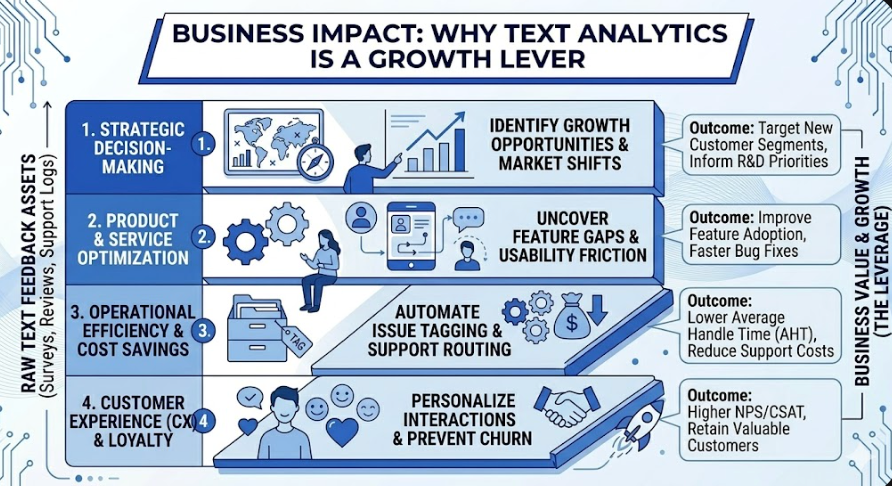
Text analytics is not just about insight generation.
It directly impacts business performance.
AI reduces time-to-insight by 40–60%, allowing you to move from delayed reporting to near real-time decisions
Text analytics identifies dissatisfaction early.
It can detect 30–45% of at-risk customers weeks before churn, enabling proactive intervention
By automating analysis and surfacing insights:
This leads to 15–25% improvement in operational efficiency
Text analytics improves:
It also reduces revenue leakage by identifying hidden friction points earlier.
Text analytics is no longer only an analytics capability. It is increasingly becoming part of operational CX infrastructure.
CX is evolving rapidly.
Customers expect you to understand them without asking repeatedly.
Data Insight - 50%+ of consumers prefer companies that infer insights from behavior and signals
You cannot rely only on surveys.
You need:
From collecting feedback → toward understanding customer context operationally
AI has fundamentally changed how text analytics works.
Modern systems can:
You can ask: “What is driving dissatisfaction in onboarding?”
And get:
Analysis becomes interactive.
From static reporting dashboards → toward more interactive operational CX visibility
As Carrie Parker explains:
“Gathering insights alone isn’t a strategy; the real value comes when you act on what you hear.”
That’s exactly what AI enables faster understanding and faster action.
Even with tools, many organizations struggle.
The Reality is 30–40% of teams don’t act on customer data
Insight without impact. Many organizations still stop at reporting and analysis without connecting insights to operational workflows and coordinated action.

High-performing teams don’t stop at decoding feedback.
They operationalize it.
feedback → operational insight → coordination → action → outcome
Most organizations assume open-ended feedback is messy and difficult to use.
But the reality is the opposite.
Text is the richest source of customer truth.
It contains:
They don’t collect more data.
They understand it faster.
Competitive advantage increasingly depends on how effectively organizations convert customer feedback into operational understanding and coordinated action.
Right now, your CX system is likely doing what most systems do well.
You’re collecting feedback. You’re running surveys, capturing open-text responses, and monitoring customer conversations across channels.
But if that feedback is not being decoded fast enough, it’s not helping you make better decisions. It’s just sitting there. And that’s where the real gap is.
If you want real impact, you need to shift from collecting data to understanding it at scale.
With a modern CXM platform, organizations can turn unstructured feedback into operational customer insight across journeys and teams.
They can:
capture open-ended feedback across surveys, chats, reviews, and support interactions
identify recurring customer friction patterns faster
improve operational visibility across journeys
coordinate issue resolution across CX, support, and operations teams
prioritize customer issues based on operational and business impact
measure outcomes across retention, efficiency, and customer experience performance
This is how text stops being unstructured noise and becomes structured intelligence.
Your customers are already telling you what’s wrong. They’re writing it in comments, saying it in chats, and expressing it in reviews.
But if you can’t understand it quickly enough, you fall behind.
The advantage is no longer only collecting feedback. It is understanding customer signals fast enough to improve operational response. See how modern CXM systems help organizations convert open-ended feedback into operational visibility, coordinated workflows, and faster CX action across teams.
Book a demo to see how customer feedback can be transformed into operational insight, coordinated action, and measurable CX outcomes.
Text analytics in CX is the process of using AI and natural language processing (NLP) to analyze unstructured customer feedback and convert it into structured insights.
This includes extracting:
It helps organizations understand the “why” behind customer behavior and feedback.
Open-ended feedback provides the context and reasoning behind customer scores like NPS and CSAT.
While structured data tells you what is happening, open-text responses explain why it is happening.
This makes it one of the most valuable sources of insight for identifying friction, dissatisfaction, and improvement opportunities.
Text analytics works through a structured pipeline:
This allows organizations to process thousands of responses in seconds instead of manually reviewing them.
Text analytics delivers several business benefits, including:
Modern AI-driven text analytics systems achieve high accuracy levels.
Accuracy depends on data quality and model tuning.
Yes, text analytics helps reduce churn by identifying dissatisfaction early.
It can detect patterns in feedback that signal risk, such as repeated complaints or negative sentiment trends.
This allows organizations to take proactive action before customers leave, reducing both visible and silent churn.
Sentiment analysis is a subset of text analytics.
Text analytics provides a complete understanding, not just emotional classification.
AI enables organizations to analyze large volumes of text quickly and accurately.
It can:
This transforms feedback analysis from manual and slow to automated and scalable.
Common challenges include:
Text analytics solves these challenges by automating interpretation and scaling analysis.
Modern CX systems integrate text analytics into a continuous loop:
This ensures feedback leads to real outcomes, not just reports.
The future of text analytics is moving toward more real-time, AI-assisted, and operationally connected CX systems.
Organizations are shifting from:
Text analytics is increasingly becoming a foundational layer within modern operational CX environments.
.png)

.png)
.svg)


